
Ride Master: Car Builder Game
Freeplay IncArcade
4.72.47K Reviews
- Version
- 5.7.2
- Installs
- 50.00M
- Age Rating
- Everyone
Screenshots




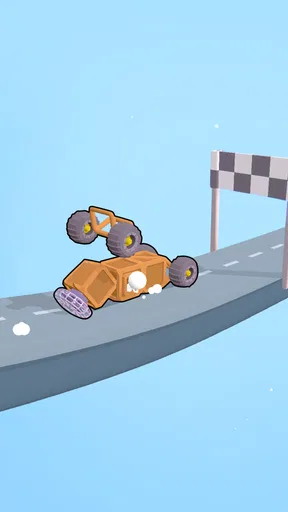



Our Review of Ride Master: Car Builder Game
 Analysis by Appyee
I went into Ride Master: Car Builder Game expecting a quick arcade distraction, and that is exactly where it works best. The game puts the focus on building a car and taking it through obstacle-course races, so the appeal is immediate: make a choice, drive, see what happens, then try again with a better idea. It is not trying to be a serious motorsport simulation, and I think that is important to understand before downloading it. Its fun comes from short experiments and fast feedback rather than long races or detailed vehicle management.
Developed by Freeplay Inc, this free arcade game is aimed at a broad audience, with an Everyone age rating. It has become a very widely played title, with over 50 million installs and a 4.7 average from around 370 thousand ratings. Those figures make sense once the basic loop clicks. You can understand the objective almost immediately, and a failed attempt rarely feels like a major setback because the next run is close at hand.
How the driving and building loop feels in practice
I find the driving-and-building loop most rewarding when I treat each run as a small test, not just a race to finish. Before changing a setup, I try to pinpoint the obstacle that caused trouble; that makes the next attempt more informative and helps keep quick retries from turning into guesswork. From there, it is worth looking at how the game’s current version fits into the experience for people who have already been playing.
The first action is simple, but the choice matters
The most appealing part of Ride Master is that the car is not just something I steer through a track. I am also deciding how it should be prepared before the obstacle course begins. That creates a small moment of planning before the action starts. I look at the challenge, consider what kind of vehicle setup might cope with it, and then commit to a run rather than spending a long time tuning every detail.
This makes the game easy to pick up in a spare moment. If I have only a few minutes, I can begin a race without learning a complicated control scheme or studying a large menu. The car-building idea gives the opening tap more meaning than a standard endless runner, because I am not simply reacting to whatever appears on screen. I am making a decision first, then testing it under pressure.
The obstacle-course format is also a better fit for this kind of arcade game than a conventional lap race would be. A lap race usually asks me to maintain a clean line and manage speed consistently. Here, the interesting question is whether the car I created can handle what is directly ahead. That turns each attempt into a compact test: the build makes a promise, and the course either supports it or exposes its weakness.
I would not approach this as a realistic car simulator. The word “builder” is useful because it describes the playful preparation side, while “racing” describes the urgency once the course begins. The experience sits between those ideas. It gives me enough control to feel responsible for the outcome, but it keeps the pace and presentation accessible instead of burying the fun under technical detail.
Feedback arrives quickly, which keeps failures useful
The strongest rhythm is the connection between action and feedback. I choose a car configuration, start moving, and quickly learn whether that decision was sensible. When the vehicle handles an obstacle well, the result feels earned because I can connect the successful passage to the preparation I made. When it struggles, I have a practical reason to reconsider the next attempt rather than simply blaming random difficulty.
That immediate response is what separates the game from a slower driving title. There is little need to wait through a long race to discover that a setup is not working. The course acts like a quick experiment. I can pay attention to where the run went wrong, adjust my approach, and get back into the action. For me, that made mistakes less frustrating than they would be in a game where every restart costs several minutes.
A useful way to play is to change one thing at a time whenever possible. If I alter the whole setup after every failed run, I may win without understanding why. A more deliberate approach is to remember the obstacle that caused trouble, make a focused adjustment, and see whether the same point becomes easier. That turns the short races into a simple form of problem solving, even though the overall presentation remains light and arcade-like.
There is a trade-off here. Players who enjoy detailed racing lines, tire behavior, realistic braking, or deep mechanical statistics may find the feedback too broad. The game communicates success through the result of the run rather than through a full engineering breakdown. I see that as a strength for casual play, but it also defines the audience. If your favorite part of a racing game is studying technical data, a dedicated simulator or a deeper garage-focused title will probably give you more to work with.
The reward is the next successful idea
Ride Master’s reward structure works best when I treat victory as confirmation that my latest idea was better than the previous one. The satisfaction is not only in reaching the end of a course. It is in watching a vehicle that previously looked unsuitable get through because I changed how I approached the build or the run. That small improvement gives the game its sense of momentum.
Because the game is free, it is also worth paying attention to the role of optional spending. In-app purchases range from $0.99 to $14.99 per item. I would recommend deciding in advance whether you want to play entirely within the free path or are comfortable buying extras, because a quick arcade game can make impulse purchases feel more tempting when attempts are short and the next challenge is always nearby.
I do not think spending should be the reason to start playing. The core appeal is the build-and-test loop, not the idea of collecting purchases. Someone who enjoys making progress through repeated attempts can get the most value by first learning the courses and understanding which decisions consistently help. That approach also makes it easier to judge whether any optional item genuinely improves your experience or merely shortens the time between attempts.
One practical tip is to use successful runs as reference points instead of immediately chasing the hardest possible challenge. If a particular setup handles a course reliably, remember what made it work. That gives you a baseline for experimenting later. Without a baseline, it is easy to confuse a lucky run with a genuinely useful build and then become frustrated when the same idea fails on the next course.
Every attempt resets cleanly, and that is the point
The reset is not an interruption in Ride Master; it is part of the design. A failed run sends me back toward another attempt while the problem is still fresh in my mind. I can remember the obstacle, the moment the car lost control, or the choice that seemed promising but did not deliver. That short distance between failure and retry is the reason another session begins so easily.
This structure suits everyday situations unusually well. I could play while waiting for a coffee, during a short break, or at the end of the day when I want something interactive but do not want to follow a complicated story. A single attempt can become several because each reset creates a new question: should I rebuild the car, change my timing, or simply try the same plan with more care?
The same quality can become a weakness if you are trying to limit screen time. Since the game makes restarting easy, it can encourage the familiar “one more attempt” habit. The low commitment of each race is convenient, but it also removes the natural stopping point that a longer campaign or a substantial match might provide. I would use it in short sessions if I wanted to keep it from taking over a break.
Another limitation is that repeated resets may feel shallow to players who want a persistent driving career. Ride Master is more about solving the immediate course than building a long-term identity as a driver. If you want licensed cars, structured championships, realistic tracks, or a garage that rewards careful long-range planning, an established racing simulator or traditional racing game is likely a better match.
Who will enjoy it, and who should choose something else
I would recommend Ride Master to players who enjoy compact arcade challenges, visual experimentation, and the satisfaction of improving after a quick failure. It is especially suitable for someone who likes games that explain themselves through play. The objective is clear, the car-building premise gives each attempt a decision point, and the obstacle course supplies immediate evidence about whether that decision worked.
It also fits families and younger players better than many realistic racing games because its age rating is Everyone. That does not mean every player will have the same experience, though. Younger users may enjoy the direct action, while adults who want a deeper mechanical system may quickly notice the simplified approach. I would still keep an eye on in-app purchases on a shared device, particularly because the game is free to install and the optional items can cost up to $14.99 each.
I would skip it if your main reason for downloading a racing game is realism. This is not where I would look for authentic vehicle handling, detailed track strategy, or a serious competition environment. I would also skip it if you dislike repeating short challenges after failure. The reset-and-retry pattern is not a side feature; it is the heart of the experience. The game expects you to learn through attempts rather than progress through one uninterrupted run.
Compared with an endless runner, Ride Master gives me more ownership because the car-building decision comes before the obstacle course. Compared with a full racing simulator, it is faster to understand and far less demanding, but it cannot offer the same depth. Compared with a conventional arcade racer, its strongest difference is the way preparation and driving are tied together. That combination gives the game a specific identity instead of making it feel like only another quick steering challenge.
Practical details before downloading
The game is free, and it runs on Android devices using Android 7.0 or later. Its current version is 4.8.8, so anyone using an older device should check the operating system before expecting to install it. The broad device compatibility helps explain why it can reach casual players who may not own a recent phone, although the actual feel will still depend on the device and the way it handles the game’s visual action.
Since the title is built around repeated attempts, I would begin with a short test session rather than deciding immediately that it must become a long-term game. Pay attention to three things: whether the building choices feel meaningful, whether the obstacles give you understandable feedback, and whether restarting feels motivating or repetitive. Those answers will tell you more about personal fit than the large install count or the high average rating.
It is also worth setting a spending boundary before handing the phone to a child or another family member. The game’s free entry is attractive, but optional purchases between $0.99 and $14.99 can change how comfortable it feels as a casual family download. Treat the purchase system as part of the decision, not as an afterthought, even if you plan to begin without spending.
My verdict on the complete action-feedback-reward-reset cycle
After playing through the loop, I think Ride Master succeeds because it keeps every stage close together. The first action is choosing how to prepare the car. The feedback comes from seeing that choice meet an obstacle course. The reward is a successful run and the knowledge that a better idea can work. The reset then places me directly in front of another attempt while the lesson is still clear.
That cycle is simple, but it is not empty. The most satisfying sessions are the ones where I stop treating each race as a random try and start using the course as information. I remember what failed, change my plan carefully, and test it again. That is the game’s most valuable hidden lesson: progress comes from making the reset informative rather than merely repeating it.
The limitations are equally clear. The driving is designed for accessibility, not simulation, and the repeated-attempt format may feel thin for players who want a campaign, realism, or deep vehicle statistics. The presence of in-app purchases also means I would approach it more carefully on a shared device. Still, for quick arcade sessions built around car creation and obstacle-course problem solving, it delivers a focused experience.
My final recommendation is straightforward: try it if you want a free, approachable game that lets you build, test, fail, and immediately rethink your next run. I would point a simulation fan elsewhere, but for casual players who enjoy seeing a small decision produce instant on-screen consequences, Ride Master: Car Builder Game is an easy title to return to. Its reason to begin another session is always the same—and effective: the last attempt showed you exactly what to try differently.
Privacy and Permissions
See what permissions an app requests and how it handles your data.
- Photos/Media/Files
- read the contents of your USB storage
- Storage
- read the contents of your USB storage
- Wi-Fi connection information
- view Wi-Fi connections
- Other
- view network connections, full network access, control vibration, prevent device from sleeping
Verdict
Strengths of Ride Master: Car Builder Game
- Simple controls make it easy to start playing immediately.
- Vehicle upgrades provide a satisfying sense of progression.
- Short levels suit quick gaming sessions on mobile devices.
- Bright visuals and playful designs appeal to casual players.
- Offline play makes it convenient when an internet connection is unavailable.
Limitations of Ride Master: Car Builder Game
- Frequent ads can interrupt gameplay, especially between levels.
- Later upgrades may require considerable grinding to unlock.
- Gameplay can become repetitive after extended sessions.
- Limited customization may disappoint players seeking detailed car building.
- Some challenges rely more on timing than meaningful driving strategy.
Other Releases by Freeplay Inc
View All
Snake Run Race・3D Running Game
Arcade4.7

Fidget Toys Trading・Pop It 3D
Simulation4.7

Count Masters: Stickman Games
Action4.6

Twerk Race 3d — Fun run game!
Arcade4.2
Similar Picks in This Category
View All
Subway Surfers
SYBO Games4.6

Stickman Party 234 MiniGames
PlayMax Game Studio4.6

Subway Princess Runner
Ivy4.4

Temple Run
Imangi Studios4.2

Zombie Tsunami
Mobigame SAS4.6

Stack Ball - Crash Platforms
CASUAL AZUR GAMES4.5
Frequently Asked Questions
What is Ride Master: Car Builder Game?
Ride Master: Car Builder Game is a casual vehicle-building and obstacle-course game for mobile devices. You assemble cars by selecting and combining different parts, then test them on challenging tracks filled with ramps, gaps, traps, and unexpected hazards. The main appeal comes from experimenting with unusual designs, improving your vehicle, and seeing whether your creation can survive each level.
How does the gameplay work in Ride Master: Car Builder Game?
The gameplay combines simple controls with light construction mechanics. Before starting a level, you choose or modify the vehicle’s components, such as wheels, body parts, and other equipment. During the course, you generally control the car with straightforward touch input while reacting to obstacles and terrain. Success depends on choosing a suitable build rather than relying only on speed.
Is Ride Master: Car Builder Game free to download and play?
Ride Master: Car Builder Game is generally offered as a free download, allowing players to begin without paying upfront. However, free mobile games commonly include optional in-app purchases, advertising, or both. These may provide extra currency, cosmetic items, upgrades, or faster progress. It is worth checking the store listing and your device’s purchase settings before downloading, especially if children may use the device.
Does Ride Master: Car Builder Game require an internet connection?
The basic levels of Ride Master: Car Builder Game may be playable without a continuous internet connection, which is convenient for short sessions while traveling. Nevertheless, some features can depend on connectivity, including advertisements, updates, online events, synchronization, or purchases. Availability may also vary between versions and devices, so you should test the game in offline mode rather than assuming every feature will work without internet access.
Is Ride Master: Car Builder Game suitable for children and casual players?
Ride Master: Car Builder Game is designed around accessible controls and colorful, arcade-style challenges, making it approachable for casual players and many younger audiences. The difficulty can still increase as tracks become more demanding, so some levels may require patience and repeated attempts. Parents should review the game’s age rating, advertising, in-app purchase options, and privacy information before allowing children to play.
Play our best games!


